


Artificial Intelligence (AI) is no longer a futuristic concept—it’s here, reshaping industries and redefining how we work. If you’re a job seeker, student, freelancer, or someone already working, the question “Will AI replace my job?” probably feels urgent. The truth is nuanced: AI will replace some tasks, but it will also create opportunities for those ready to adapt. Let’s break it down together.
Understanding the AI Job Disruption
When people say “AI will replace jobs,” they often imagine robots taking over entire professions. In reality, AI usually replaces tasks within jobs, not the whole role. For example, accountants now use AI software to automate repetitive bookkeeping, but their advisory and strategic work has become more valuable.
Think of AI as a powerful assistant—it can crunch numbers, analyze data, or draft text quickly, but it still needs human oversight, creativity, and empathy.
Jobs Most at Risk from AI
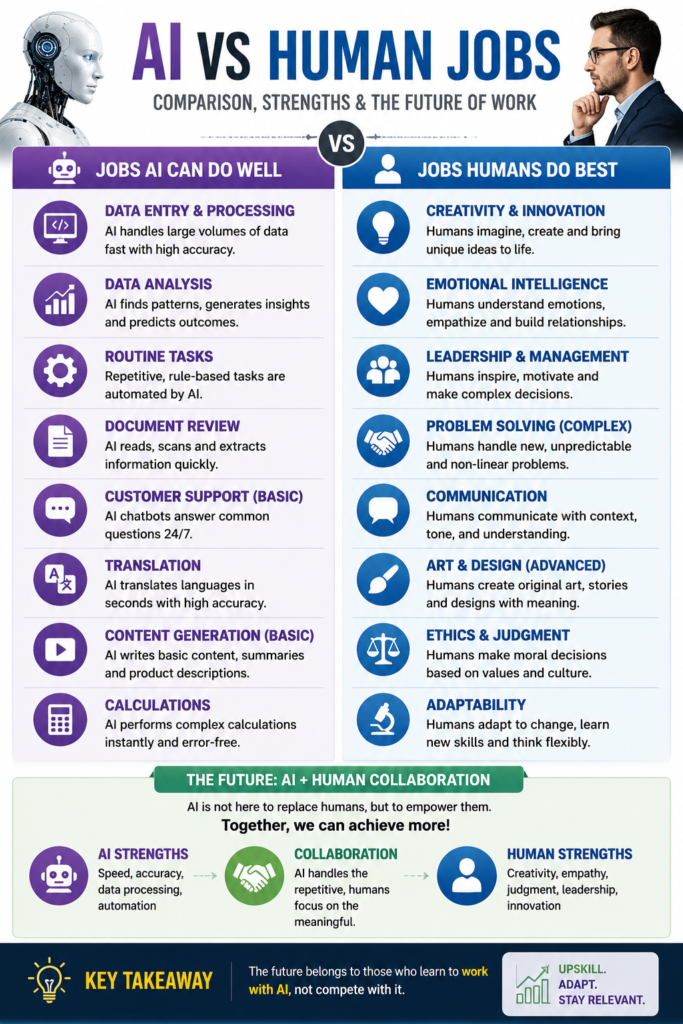
Certain jobs are more vulnerable because they rely on repetitive, predictable tasks.
- Data entry clerks: AI can process information faster and with fewer errors.
- Telemarketers: Automated chatbots and voice assistants are already replacing cold calls.
- Paralegals: AI tools can scan legal documents in seconds, reducing the need for manual review.
Freelancers in content creation also face competition from AI writing tools. For instance, platforms like ChatGPT or Jasper can generate blog drafts, but clients still value human creativity, storytelling, and originality.

Jobs That Are Safe (and Growing)
Not all jobs are at risk. In fact, many roles are becoming more important because AI cannot replicate human qualities.
- Teachers and mentors: AI can provide information, but it cannot inspire or emotionally connect with students.
- Healthcare workers: Empathy, bedside manner, and ethical decision-making are irreplaceable.
- Creative strategists: AI can suggest ideas, but humans bring originality and cultural context.
- AI ethicists and regulators: As AI grows, so does the need for oversight and ethical frameworks.
Students and learners should focus on careers that combine technical knowledge with creativity and human interaction.
Emotional Impact of AI on Workers
Beyond statistics, there’s the human side: fear, anxiety, and uncertainty. Many professionals worry about being left behind.
Here’s the good news: history shows that every technological revolution—from the industrial age to the internet—created more jobs than it destroyed. The key is resilience. Instead of fearing AI, see it as a tool to enhance your career.
Practical tip: If you feel anxious, start small. Learn one AI tool relevant to your field. For example, a freelancer can experiment with Canva’s AI design features, or a student can use AI research assistants to speed up study sessions.


Will AI Replace My Job?7 Survival Strategies to Future‑Proof Your Career
Will AI Replace My Job-
Here’s how you can stay ahead:
- Audit your skills: Write down what you do daily. Identify tasks AI could automate and focus on the ones requiring human judgment.
- Learn soft skills: Creativity, negotiation, and leadership are AI‑proof.
- Upskill digitally: Platforms like Coursera, LinkedIn Learning, and Udemy offer courses in AI literacy and future‑proof skills.
- Build a personal brand: Share your expertise on LinkedIn or Medium. Employers value visibility.
- Network smartly: Join communities in industries less vulnerable to automation, like healthcare or education.
- Stay updated: Follow AI news on Google Trends or Forbes Tech to anticipate changes.
- Diversify income: Freelancers can combine AI‑assisted work with unique human services, like consulting or coaching.
Global Perspective – AI & Jobs Around the World
AI adoption isn’t uniform worldwide.
- United States: Rapid adoption in tech and finance, but strong demand for AI ethics and regulation.
- Europe: The EU AI Act emphasizes responsible AI, creating jobs in compliance and oversight.
- India: AI is booming in IT services, but government initiatives also focus on reskilling youth.
- Asia (Japan, South Korea): Heavy investment in robotics, but cultural emphasis on human‑centered service jobs remains strong.
This global view shows that while some regions face faster disruption, others are creating new opportunities through policy and innovation.
Case Studies – Humans Working with AI
Will AI Replace My Job-
- Accountants: Firms now use AI for tax calculations, but accountants spend more time advising clients on financial strategy.
- Freelancers: A graphic designer uses AI tools to generate drafts quickly, then adds personal creativity to deliver unique designs.
- Students: AI helps with research, but critical thinking and analysis remain essential for academic success.
These examples prove that AI doesn’t eliminate jobs—it changes them.
FAQs
Will AI replace all jobs? No. AI will automate tasks, but humans will remain essential for creativity, empathy, and decision‑making.
Which jobs should students focus on? Tech‑enabled roles combined with human skills: data science, design, healthcare, and education.
Can freelancers survive AI disruption? Yes. By using AI tools to boost productivity while offering unique human insights, freelancers can thrive.
Conclusion & Call to Action
So, will AI replace my job? The answer is: not entirely. AI will reshape jobs, but those who adapt will find new opportunities. The future belongs to learners, creators, and problem‑solvers.
👉 Don’t wait for disruption to catch you off guard. Start reskilling today, embrace AI as your ally, and build a career that thrives in the age of automation.
Leave a Reply Cancel reply